
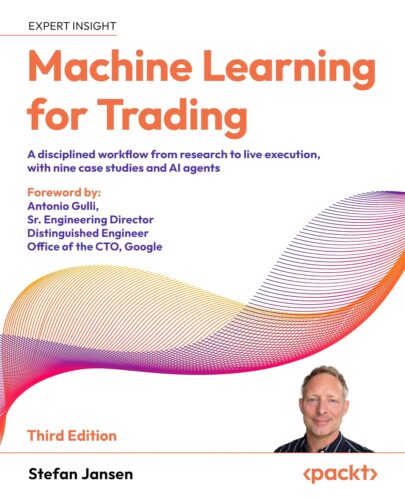
Machine Learning for Trading: A disciplined workflow from research to live execution, with nine case studies and AI agents
Build and deploy AI-driven trading systems using the 7-Stage workflow with pandas, Polars, LightGBM, PyTorch, Optuna, zipline-reloaded, MLflow, Feast, and SHAP
Key FeaturesBuild point-in-time pipelines, integrate alternative data, and ensure data integrityBuild and validate predictive models using GBMs, Transformers, and causal inference frameworks to create robust, interpretable alpha signalsDeploy RAG systems, autonomous financial agents, and diffusion-based synthetic data generatorsBook Description
The rapid rise of AI and the growing complexity of financial markets have transformed quantitative trading into a data-driven, process-oriented discipline. This third edition provides a comprehensive blueprint for designing, validating, and deploying systematic trading strategies powered by modern machine learning.
It introduces the 7 stage ML4T Workflow, a professional framework that unites data engineering, model development, validation, and live deployment into one cohesive process. It demonstrates how to turn raw market, fundamental, and alternative data into predictive signals and robust, production-ready trading systems.
You’ll learn to build advanced pipelines for feature engineering, model evaluation, and portfolio optimization using libraries such as Polars, LightGBM, PyTorch, and Optuna.
Practical notebooks illustrate every stage of the workflow, from factor testing and backtesting with zipline reloaded to live deployment with MLOps tools such as MLflow, Feast, and Prometheus. Additional coverage of synthetic data generation, Graph Neural Networks, and Reinforcement Learning extends the toolkit for building resilient, adaptive strategies that thrive in dynamic markets.
By the end of this book, you’ll be proficient to build your own industrial-grade “alpha factory”.
What you will learnTransform raw data into predictive alpha factors, validated with leak-proof cross-validationMaster advanced models, from Gradient Boosting Machines to Transformers, Graph Neural Networks, and Reinforcement Learning agentsHarness Generative AI, Retrieval Augmented Generation, and Causal Inference to make models interpretable, auditable, and compliant with regulatory standardsBuild production-ready trading infrastructure using MLOps, feature stores, and model monitoring to transition research into live capital deployment safelyWho this book is for
If you are a data analyst, data scientist, Python developer, investment analyst, or portfolio manager interested in getting hands-on machine learning knowledge for trading, this book is for you. This book is for you if you want to learn how to extract value from a diverse set of data sources using machine learning to design your own systematic trading strategies.
Some understanding of Python and machine learning techniques is required.
Table of ContentsThe Process is Your EdgeThe Financial Data UniverseMarket MicrostructureFundamental and Alternative DataSynthetic Financial DataStrategy Research FrameworkDefining the Learning TaskFinancial Feature EngineeringModel-Based Feature ExtractionText Feature EngineeringThe ML PipelineAdvanced Models for Tabular DataDeep Learning for Time SeriesLatent Factor ModelsCausal Machine LearningStrategy SimulationPortfolio ConstructionTransaction CostsRisk ManagementStrategy SynthesisReinforcement LearningRAG for Financial ResearchKnowledge GraphsAutonomous AgentsLive Trading SystemsMLOps and GovernanceThe Systematic Edge
From the Publisher
Customer Reviews
4.5 out of 5 stars 20
4.4 out of 5 stars 422
Organization
27 chapters grouped by workflow stage, from trading idea and data to live trading 24 chapters grouped by model family
Worked applications
Nine case studies, one shared pipeline, across equities, ETFs, FX, futures, crypto, options Standalone examples, a different market and method in each chapter
Research method
One framework: labels, evaluation protocol, run log, search accounting, sealed holdout An ML process chapter and a model-to-backtest workflow chapter
Notebooks and code
Over 450 notebooks, tested in CI; no printed listings; six pip-installable libraries 159 notebooks; code listings printed in the book; one utils module
Feature engineering
Adds model-based features (volatility, regime, uncertainty) and transformer text models Technical and fundamental alpha factors; text as bag-of-words and word2vec
Models
Adds time-series deep learning, latent-factor asset pricing, portfolio learning, RL for execution Linear, random forest, boosting, CNN, RNN, autoencoder, GAN, one DQN agent
Causal analysis
Double machine learning, Bayesian structural time series, causal discovery, refutation Predictive models only; relationships treated as correlations
Generative AI & AI Agents
Three chapters: retrieval-augmented filings research, knowledge graphs, AI agents Published in 2020, before the LLM era; covered embeddings
Costs and risk
Two chapters: cost models and Almgren-Chriss execution; VaR, stress tests, kill switches Portfolio optimization and performance metrics in one evaluation chapter
Production
Live broker integration, order lifecycle, drift monitoring, MLOps, and governance Ends at the backtest and its performance report