
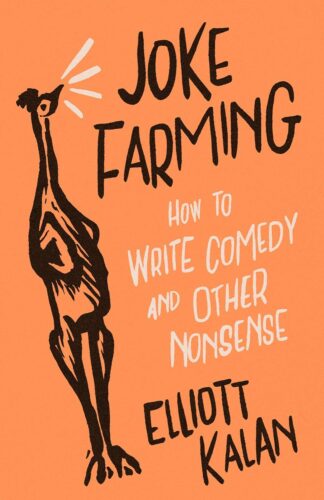
The winner of four Emmys, a Peabody, and two Writers Guild Awards (all of which badly need dusting) explains his process for writing comedy without going insane.
Philosophers may debate the meaning of comedy (thankfully keeping them too busy to fall into a life of crime), but the rest of us are more likely to wonder how we can make an audience laugh—or at least, how to entertain our friends and followers. According to award-winning comedy writer Elliott Kalan, we need to stop staring out the window, waiting for hilarious bits to stroll into view, fully formed. What we need is a process to plant their premises, tend to their structure and wording, and ultimately harvest them as funny material. In short, a farm. But for jokes.
In Joke Farming, Kalan explains that it’s easier to write jokes when you have a dependable method for doing so. All jokes, he argues, are built from the same elements: structure, premise, voice, tone, wording, and audience—and these elements can be applied to any comedic genre, from stand-up to sitcoms to satire. Kalan analyzes examples from his own career—including jokes that he wrote (and rewrote and rewrote and rewrote . . . ) as head writer for The Daily Show with Jon Stewart—as well as material from a diverse array of comedians, writers, and filmmakers, highlighting the phrasing, rhythm, and precise details that make their work so dang funny.
Drawing on his experiences in professional writers’ rooms as well as episodes from everyday life, Kalan’s guide to jokes will appeal to aspiring writers, their mentors, comedy fans, and anyone who has to speak at a wedding. Joke Farming points the way toward a writing process that lessens stress and agony and yields more reliable rewards: a surprising tagline, a hilarious word choice, and—most importantly—a bigger laugh from the audience, whoever they may be.
From the Publisher
What makes a joke funny (or not)?
All jokes are about communication, so what makes a joke funny is a combination of 1) what the joke is communicating and 2) how it’s being communicated. Is the joke saying something that an audience member either relates to deeply or is totally surprised by? Is it written and told in a way that gives the audience just the right amount of information (not too much and not too little) to understand what’s being said? Does the joke use specific details (“the nauseous clown plummeted off a thirty foot cliff”) rather than vague generalities (“a guy fell down”)? These are all ways to craft a joke that is more likely to be laughed at.
Of course, not everyone has the same sense of humor or laughs at the same jokes. That’s okay. Why should everyone think the same things are funny? By that logic, we all should love every hit song, and I will go to my grave refusing to like “Kokomo” by the Beach Boys.
Does a joke have to have a point?
All jokes have a point of some kind, though that doesn’t mean all jokes have a message that we’re intended to be convinced by. It could be something as basic as “We do things that don’t make sense” or “People make too many assumptions” or “Real animals don’t use sticks of dynamite”. Or it can be as complicated as “Here’s why this specific political policy is wrongheaded” or “Humanity is a tiny speck in an indifferent cosmos.” Not every joke needs to make a deep, profound point. This isn’t poetry or philosophy or a high school goth’s journal. But just as we can’t help having feelings and opinions, our jokes can’t help reflecting those feelings and opinions. So even a really basic, stupid joke has a point to it — it just might be a really basic, stupid point. This is all to say, you can write a joke just by having a funny idea, without consciously knowing what point the joke is communicating. But you can write stronger jokes when you do know what that point is.
How can readers refine their own writing process?
There are times when a joke pops into my head with very little conscious thought on my part. My personal writing process came about because I tried to break down that unconscious process into steps so that I could repeat it deliberately. I’d advise any writer to think about how they think and try to build a process out of it. For me, that means going through steps of looking at the purpose of the joke I’m trying to write, clarifying for myself what point I’m trying to make, and asking “What if” questions about that point to spark ideas for joke premises. By breaking it down into steps like these, I can write jokes quicker and with more reliable results. So I guess the first step in refining your writing process is to figure out what your mental writing process is. Making a cup of tea, putting on your favorite music, and then staring into space until you get an idea? That’s not a writing process. It sounds very relaxing, though.
ASIN : B0DZJ4DKHM
Publisher : University of Chicago Press
Accessibility : Learn more
Publication date : November 12, 2025
Language : English
File size : 2.9 MB
Screen Reader : Supported
Enhanced typesetting : Enabled
X-Ray : Not Enabled
Word Wise : Enabled
Print length : 322 pages
ISBN-13 : 978-0226829944
Page Flip : Enabled
Best Sellers Rank: #74,173 in Kindle Store (See Top 100 in Kindle Store) #1 in Humor Literary Criticism (Kindle Store) #13 in Humor Literary Criticism (Books) #16 in Fiction Writing Reference (Books)
Customer Reviews: 5.0 5.0 out of 5 stars (4)