
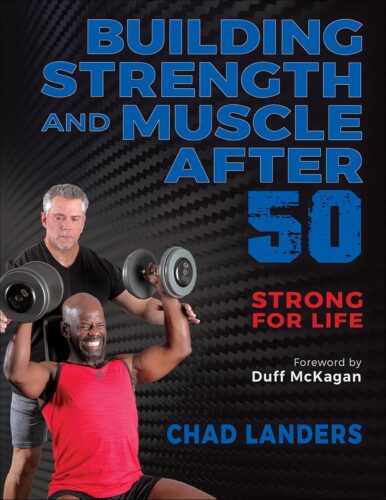
Muscle and strength have no age limits.
With Building Strength and Muscle After 50, you can benefit from over 30 years of personal training experience from Chad Landers, who has trained high-profile clients such as Duff McKagan, William Zabka, Jerry Cantrell, Stephen Perkins, and Catherine Dent. He will guide you through the physical, hormonal, and mental hurdles that trainees over age 50 encounter in their efforts to build and maintain muscle and definition.
Building Strength and Muscle After 50 describes the importance of recovery, the value of resistance training, and the most effective ways to reduce the risk of injury while training. Landers discusses the big three age-related health issues—sarcopenia, metabolism decline, and osteoporosis—and will help you develop an approach to building strength that meets you where you’re at.
The book contains 76 exercises for the entire body:
20 chest and back exercises26 shoulder, biceps, and triceps exercises12 core exercises18 hip, thigh, and calf exercises
Whether you’re returning to resistance training after a break or you’ve never picked up a weight before, the step-by-step instructions for each exercise make this an accessible and approachable resource. Chad’s Take sections offer ways to maximize results and vary or modify an exercise for your unique goals. With nine programs ranging from two to four lifts per week, you can pick the plan that fits your schedule.
Practical and accessible, this resource is complete with a chapter on nutrition guidance to help you fuel correctly and contains an abundance of pop culture references meant to make the reading experience more enjoyable. Landers has trained dozens of clients in their 50s, 60s, 70s, 80s, and even 90s, proving that it’s never too late to claim or reclaim your strength at any stage of life!
Earn continuing education credits/units! A continuing education exam that uses this book is also available. It may be purchased separately or as part of a package that includes both the book and exam.
From the Publisher
Feeling strong never gets old
Explore the benefits of strength training after 50
Learn how to safely build and maintain strength and muscle beyond the age of 50 with Building Strength and Muscle After 50. With over 30 years of experience as a personal trainer, Chad Landers is ready to guide you through the physical, hormonal, and mental hurdles that trainees over age 50 encounter in their efforts to build and maintain muscle.
Learn the importance of recovery, the value of resistance training, and the most effective ways to reduce the risk of injury while training. Includes 76 exercises covering the entire body Discover insights into age-related health issues like sarcopenia, metabolism decline, and osteoporosis Take comfort in knowing that it’s never too late to reclaim your strength at any stage of life!
Parial FIGURE 14.1 Training and heart rate zones.
Zone 2 training refers to the percentage of your maximum heart rate you maintain during training based on five heart rate zones (figure 14.1).
Common recommendations for Zone 2 training are 120 minutes a week for beginners and 180 to 240 minutes weekly for more advanced trainees. This much cardio is only possible because the intensity of Zone 2 is so low, and it’s very easy to recover from. However, I don’t do anywhere near this much, and I don’t think most 50-somethings who aren’t early retirees will have the time to dedicate to that much cardio in addition to the recommended weight training.
FIGURE 5.6 Hip warm-up: world’s greatest stretch.
Step into a deep lunge with your back leg extended and both hands on the floor inside the front foot. Rotate your upper body toward the front leg, reaching that arm toward the ceiling.
Hold briefly, then return to the floor and switch sides. This opens up the hips, thoracic spine, and hamstrings in one movement.
Dumbbell Hammer Curl
INSTRUCTION
• Stand with feet shoulder-width apart and hold a dumbbell in each hand, hands at your sides, palms facing your thighs (figure a).
• Curl the dumbbells toward your shoulders, keeping your palms facing each other. A cue I use is to have the dumbbells “frame the pecs” at the top, so the weight on the top end of the dumbbell is above the pecs and the weight on the bottom is below. If you curl so high you can see the bottom side of the dumbbell in the mirror, your elbow has come forward and you’ve curled too high (figure b).
• Slowly lower the dumbbells back to the starting position and repeat.
ASIN : B0F9NJDBF3
Publisher : Human Kinetics
Accessibility : Learn more
Publication date : November 3, 2025
Language : English
File size : 78.0 MB
Enhanced typesetting : Enabled
X-Ray : Not Enabled
Word Wise : Enabled
Print length : 216 pages
ISBN-13 : 978-1718223899
Page Flip : Enabled
Best Sellers Rank: #191,724 in Kindle Store (See Top 100 in Kindle Store) #78 in Weight Training (Kindle Store) #90 in Weight Training (Books) #121 in Aging & Longevity (Books)
Customer Reviews: 5.0 5.0 out of 5 stars 8 ratings