
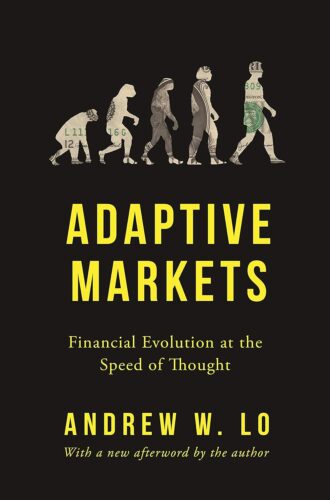
A new, evolutionary explanation of markets and investor behavior
Half of all Americans have money in the stock market, yet economists can’t agree on whether investors and markets are rational and efficient, as modern financial theory assumes, or irrational and inefficient, as behavioral economists believe. The debate is one of the biggest in economics, and the value or futility of investment management and financial regulation hangs on the answer. In this groundbreaking book, Andrew Lo transforms the debate with a powerful new framework in which rationality and irrationality coexist—the Adaptive Markets Hypothesis. Drawing on psychology, evolutionary biology, neuroscience, artificial intelligence, and other fields, Adaptive Markets shows that the theory of market efficiency is incomplete. When markets are unstable, investors react instinctively, creating inefficiencies for others to exploit. Lo’s new paradigm explains how financial evolution shapes behavior and markets at the speed of thought—a fact revealed by swings between stability and crisis, profit and loss, and innovation and regulation. An ambitious new answer to fundamental questions about economics and investing, Adaptive Markets is essential reading for anyone who wants to understand how markets really work.
ASIN : B07R4C6PDZ
Publisher : Princeton University Press
Accessibility : Learn more
Publication date : May 14, 2019
Edition : 2nd
Language : English
File size : 15.9 MB
Screen Reader : Supported
Enhanced typesetting : Enabled
X-Ray : Enabled
Word Wise : Enabled
Print length : 503 pages
ISBN-13 : 978-0691196800
Page Flip : Enabled
Best Sellers Rank: #253,458 in Kindle Store (See Top 100 in Kindle Store) #30 in Business Planning & Forecasting (Kindle Store) #40 in Business Planning & Forecasting (Books) #78 in Economic Theory (Kindle Store)
Customer Reviews: 4.4 4.4 out of 5 stars (511)