
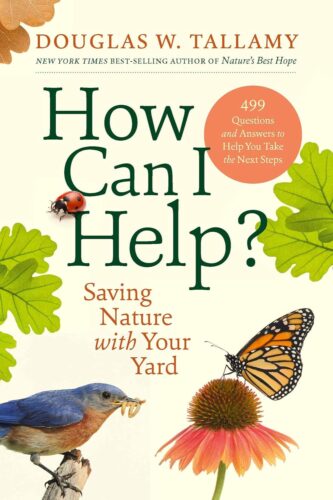
From a New York Times bestselling author, a wildlife ecology expert and environmental advocate provides readers with the next step in their ecological journey.
In How Can I Help?, Tallamy tackles the questions commonly asked at his popular lectures and shares compelling and actionable answers that will help gardeners and homeowners take the next step in their ecological journey. Topics range from ecology, evolution, biodiversity and conservation to restoration, native plants, invasive species, pest control, and supporting wildlife at home. Tallamy keenly understands that most people want to take part in conservation efforts but often feel powerless to do so as individuals. But one person can make a difference, and How Can I Help? details how.
Whether by reducing your lawn, planting a handful of native species, or allowing leaves to sit untouched, you will be inspired and empowered to join millions of other like-minded people to become the future of backyard conservation.
From the Publisher
BIODIVERSITY
Q: Do you really believe that non-native plants could possibly threaten the continued viability of necessary insect populations? It really seems far-fetched to me that there could be enough of these and other plants to threaten your insects.
A: First, let me emphasize that science is not a discipline based on beliefs, but one based on testable hypotheses. I have tested many times the hypothesis that non-native plants support fewer insects (both insect herbivores and pollinators) than do native plants. I always get the same answer: they do not.
NATIVE AND NON-NATIVE PLANTS
Q: Is there such a thing as a “good” or “bad” native plant?
A: Good or bad at what? Are there native plants that will take over large areas, expelling all other species the way so many invasives do? No. But there are native plants we can call “aggressive,” and we should plant them with that in mind. But many smaller flowering annuals and perennials support more pollinators than larger woody plants do. Different plants are good at different things. To cover all of the bases, your best bet is to plant a diversity of plant ty pes wherever you can.
INVASICE SPECIES
Q: What is the definition of invasive?
A: An invasive species is a non-native organism that displaces native species. I often hear people misusing the term. The other day, for example, I heard a woman say that she didn’t like Virginia creeper because it was invasive. She may not like Virginia creeper—a valuable native plant in terms of its contributions to food webs—but a native plant cannot, by definition, be classified as invasive.
PEST CONTROL
Q: What are your thoughts about the value of releasing beneficial insects, such as minute pirate bugs and Neoseiulus species predatory mites, to control pests in a small home garden with a history of some chemical use?
A: In theory, adding predators to a garden can suppress pest populations, but it is difficult to make this work. Large pest populations must be present when you release the predators so that the predators can increase their own populations. The fact that pesticides were once used in the garden shouldn’t be a problem unless they depressed the pest populations below what is needed to keep the predators around. If there are not enough pests for the predators to eat, they won’t stick around.
CONSERVATION AND RESTORATION
Q: What single thing could home gardeners do to start sharing their yards with the natural world?
A: Plant an oak tree! Oaks support more biodiversity, sequester more carbon, and manage the watershed better than any other tree in most parts of North America. They also support pollinators, even though oaks are wind pollinated. Bees regularly go to oak catkins and gather pollen, which they then feed to their young. Start with the smallest tree you can find (acorns are free!). You will end up with a faster growing, healthier tree this way.
SUPPORTING WILDLIFE AT HOME
Q: Is it good to feed the birds?
A: When done properly, feeding birds certainly is good—at least during winter and spring. Our bird feeders attract species that spend their winters in our yards (migrants that fly south for winter are insectivores and therefore not interested in seed). Most non-migrants depend heavily or entirely on seed and the fats they get from suet cakes, both of which are in very short supply in a typical residential landscape.
Customer Reviews
4.8 out of 5 stars 2,226
4.6 out of 5 stars 131
4.8 out of 5 stars 1,421
4.8 out of 5 stars 1,051
4.7 out of 5 stars 483
“If you’d like to turn your own little postage stamp of native soil into a conservation effort, Nature’s Best Hope, is a great place to begin.” —New York Times “Authors like Tallamy are aying the groundwork for a better climate future by tapping into children’s inborn compassion, curiosity and sense of justice.” ―The New York Times “A fascinating study of the trees, shrubs, and vines that feed the insects, birds, and other animals in the suburban garden.” —The New York Times “There’s a payoff for the environment, yes, but also for each of us, in the bonds of personal connection. Tallamy feels it, down to the last acorn.” —The New York Times “Two giants of the natural gardening world, Rick Darke and Doug Tallamy, have collaborated on their best work yet.” —The New York Times
ASIN : B0DC67WTML
Publisher : Timber Press
Accessibility : Learn more
Publication date : April 8, 2025
Language : English
File size : 55.4 MB
Screen Reader : Supported
Enhanced typesetting : Enabled
X-Ray : Enabled
Word Wise : Enabled
Print length : 376 pages
ISBN-13 : 978-1643264738
Page Flip : Enabled
Best Sellers Rank: #141,303 in Kindle Store (See Top 100 in Kindle Store) #3 in Organic & Sustainable Gardening & Horticulture #8 in Environmentalism #14 in Organic & Sustainable Gardening & Horticulture eBooks
Customer Reviews: 4.7 4.7 out of 5 stars 98 ratings