
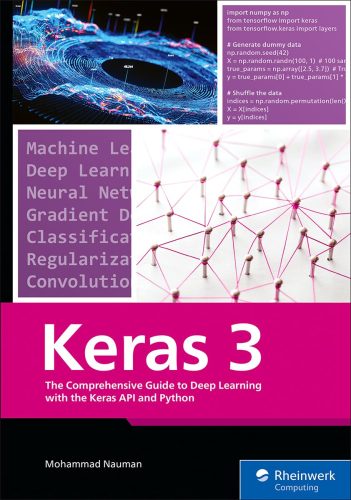
Harness the power of AI with this guide to using Keras! Start by reviewing the fundamentals of deep learning and installing the Keras API. Next, follow Python code examples to build your own models, and then train them using classification, gradient descent, and regularization. Design large-scale, multilayer models and improve their decision making with reinforcement learning. With tips for creating generative AI models, this is your cutting-edge resource for working with deep learning!
Learn to use Keras for deep learningWork with techniques such as gradient descent, classification, regularization, and moreBuild and train convolutional neural networks, transformers, and autoencoders
Deep Learning Basics
Understand the foundations of deep learning, machine learning, and neural networks. Learn core concepts like gradient descent, classification, and regularization to fine-tune your models and minimize loss function.
Model Development and Training
Follow step-by-step instructions to build models in Keras: develop a convolutional neural network, apply the functional API for complex models, and implement transformer architecture. Use reinforcement learning to improve your models’ decision-making.
Generative AI Models
Build and train your own generative AI models! Get hands-on with text to image techniques and work with variational autoencoders and generative adversarial networks.
Neural networksGradient descentClassificationRegularizationConvolutional neural networks (CNNs)Functional APITransformer architectureReinforcement learningAutoencodersStable Diffusion
From the Publisher
Master the latest deep learning techniques!
Develop and train your own deep learning models!
This is your all-in-one resource for learning Keras—a high-level, Python-based API used to build neural networks and deep learning models. It has a user-friendly frontend that makes it ideal for anyone new to the world of AI. If you’re a beginner, start with the comprehensive overview of deep learning, machine learning, and core neural network concepts like gradient descent, classification, and regularization. Experts looking for more advanced guidance can dive right into building and training complex, multilayer models with the functional API.
Each chapter introduces the theory and key concepts of a topic, using equations to illustrate the math behind each algorithm. Once you have the theory down, you’re ready to work with Keras in practice.
Follow step-by-step instructions for building and training a deep learning model, from implementing a CNN to improving decision making with reinforcement learning. Solve real-world challenges around text generation, image classification, and AI-driven gameplay using numerous case studies.
This book is based on Keras 3, which can be run on top of popular frameworks like PyTorch, TensorFlow, or JAX. It contains the latest advancements in neural network programming, including reinforcement learning, transformer architecture, and generative AI models.
Gradient descent and classification Regularization Convolutional neural networks (CNNs) Functional API Transformers Reinforcement learning Autoencoders Generative AI and Stable Diffusion
Inside the book:
This book is for anyone interested in or working with deep learning models, including developers, machine learning engineers, data scientists, and research scientists. Beginners will benefit from the primer on deep learning, while professionals and experts will find in-depth instructions for the latest advanced techniques. No previous experience with machine learning development is required—all you need is basic knowledge of Python, and you’re ready to get started with Keras!
This book includes:
A foundational introduction to deep learningStep-by-step instructions for building and training modelsDiagrams, charts, andmathematic equationsDetailed, numbered code listingsCase studies that feature real-world applicationsCode examples and Jupyter notebooks available for downloadA comprehensive index
Meet the author:
Dr. Mohammad Nauman is a seasoned machine learning expert with more than 20 years of teaching experience and a track record of educating 40,000+ students globally through his paid and free online courses on platforms like Udemy and YouTube. He has a post-doctorate degree from Max Planck Institute for Software Systems, Germany. He holds a PhD in computer science, with his groundbreaking work at the Max Planck Institute focusing on applying machine learning to advance security and privacy solutions. Dr. Nauman’s teaching philosophy—rooted in bridging theory and practice—empowers learners to master tools while building robust foundational skills, whether in academic settings or through his widely accessible digital programs.
Customer Reviews
5.0 out of 5 stars 2
4.7 out of 5 stars 175
4.7 out of 5 stars 16
5.0 out of 5 stars 3
4.7 out of 5 stars 11
Price
$44.99$44.99 $41.31$41.31 $41.31$41.31 $50.70$50.70 $32.32$32.32
What is it? (What does it teach)
Your practical introduction to programming neural networks! The ultimate Python 3 guide for all levels! Your hands-on guide to using Python for scientific computing! Develop your own gen AI applications with Python! A beginner’s guide to developing AI applications!
What you’ll learn?
Learn to program, train, and optimize neural networks using Python, covering key concepts like algorithms, activation functions, and transfer learning, while providing a practical introduction to AI, machine learning, and deep learning. Learn to write effective Python code. Cover core concepts like functions, modularization, and object orientation, and explore data types. Dive into advanced topics, including Django and GUIs. Master Python for engineering and science with hands-on exercises. Learn to use NumPy, SymPy, and Matplotlib for calculations, simulations, and data analysis. Learn to to work with pretrained LLM and NLP models on Hugging Face and LangChain, create vector databases, implement retrieval-augmented generation, and add agentic systems using frameworks like crewAI and AutoGen. This guide teaches you how to build your own AI applications from scratch, starting with no-code tools and progressing to basic Python programming, covering key AI methods and tools like AutoKeras, ChatGPT, and DALL-E.
Who is this book for?
Developers, data analysts, and engineers Python programmers Students, professional engineers, and scientists without any background in programming or Python. Python developers Developers (professionals and students)
Key Features?
Step-by-step instructions, color diagrams, code listings, sample applications, and downloadable projects for hands-on experimentation. Step-by-step instructions and downloadable code are available. Detailed sample code, diagrams, and screenshots. Downloadable programs and source code are also provided. Step-by-step instructions and detailed listings, with downloadable code examples. Step-by-step instructions, screenshots and diagrams, and downloadable code for hands-on practice.
Level of difficulty?
This book caters to both beginners with a crash course in Python and mathematical concepts, and more advanced readers eager to start programming neural networks. Beginners to professional programmers. The book assumes that readers can work with computers proficiently and have mastered the technical science of their field. Python programming is a prerequisite for this book because the language is central to most AI systems. Readers will complete a simple no-code exercise with a sample dataset, then apply their knowledge to a more complex, beginner-friendly exercise.
ASIN : B0FHSM2ZHT
Publisher : Rheinwerk Computing
Accessibility : Learn more
Publication date : October 29, 2025
Language : English
File size : 20.1 MB
Simultaneous device usage : Unlimited
Screen Reader : Supported
Enhanced typesetting : Enabled
X-Ray : Not Enabled
Word Wise : Not Enabled
Print length : 597 pages
ISBN-13 : 978-1493227396
Page Flip : Enabled
Best Sellers Rank: #413,686 in Kindle Store (See Top 100 in Kindle Store) #59 in Data Modeling & Design (Kindle Store) #126 in Neural Networks #165 in Data Modeling & Design (Books)