
GENERATIVE AI, LLMs & AI AGENTS: Foundations, Architectures, and the Engineering of Intelligent Systems
Generative Artificial Intelligence has moved, within the space of a very few years, from a specialised research pursuit to a technology that touches how millions of people write, code, design, and make decisions every day. It has also become, unavoidably, a subject that is discussed a great deal and understood carefully by comparatively few. This book was written to close that gap – to give a motivated reader, whether a student, an engineer, a researcher, or simply a curious professional, a genuine, mathematically grounded understanding of how these systems actually work, from the first principles of a single artificial neuron through to the autonomous, tool-using AI agents at the frontier of the field today.
The book is organised in four parts, and it is written to be read in order, though each chapter is also reasonably self-contained for readers who wish to use it as a reference. Part I builds the mathematical and neural-network foundations required for everything that follows. Part II covers generative modelling proper – autoencoders, generative adversarial networks, diffusion models, and the Transformer architecture – culminating in a full account of how large language models are pretrained and scaled. Part III addresses how a raw pretrained model becomes a genuinely useful, aligned, and evaluable system, through fine-tuning, reinforcement learning from human feedback, prompt engineering, retrieval-augmented generation, and rigorous evaluation methodology. Part IV, the newest and fastest-moving material in this book, is devoted to AI agents: their architectures, their planning and tool-use strategies, their coordination in multi-agent systems, and their responsible, well-governed deployment in real projects.
A few choices in how this book is written are worth stating plainly. First, every major concept is developed from its mathematical foundation rather than presented as a black box – the reader who works through Chapter 2 carefully will find that very little in the later chapters requires an unexplained leap of faith. Second, the book treats capability and responsibility as inseparable: wherever a powerful technique is introduced, its failure modes, risks, and mitigations are discussed alongside it, and Chapter 20 is devoted entirely to the ethical and governance dimensions of this field. Third, the book is deliberately full of worked examples, diagrams, tables, and runnable code listings, in the conviction that generative AI is best understood by seeing its ideas made concrete, not merely described in prose.
This is a field that will continue to change quickly, and some of the specific systems and figures discussed in these pages will, in time, be superseded. What I have tried hardest to make durable is the underlying structure of ideas – the mathematics of attention, the logic of alignment, the architecture of an agent’s reasoning loop – so that a reader who masters this book is well equipped not only to understand the generative AI of today, but to make sense of whatever comes next.
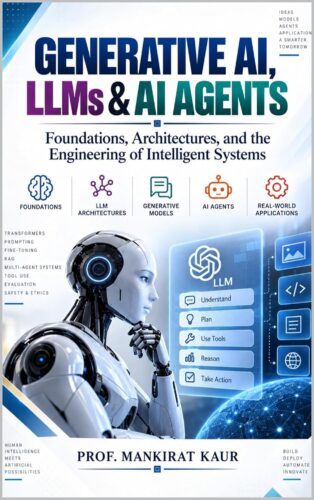
کتاب GENERATIVE AI, LLMs & AI AGENTS: Foundations, Architectures, and the Engineering of Intelligent Systems [انگلیسی]
برای دریافت این کتاب از تلگرام به audial2@ پیام دهید.
لینک آمازون: https://amazon.com/dp/B0HKCVS29Q
Description