
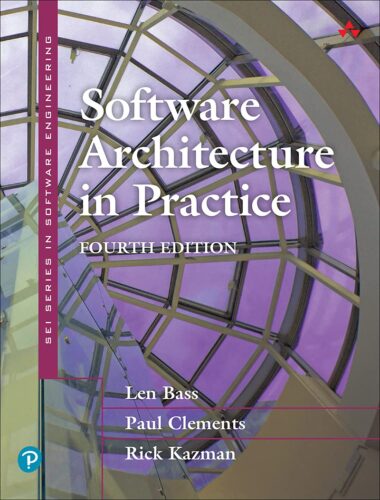
The Definitive, Practical, Proven Guide to Architecting Modern Software–Fully Updated with New Content on Mobility, the Cloud, Energy Management, DevOps, Quantum Computing, and More
Updated with eleven new chapters, Software Architecture in Practice, Fourth Edition, thoroughly explains what software architecture is, why it’s important, and how to design, instantiate, analyze, evolve, and manage it in disciplined and effective ways.
Three renowned software architects cover the entire lifecycle, presenting practical guidance, expert methods, and tested models for use in any project, no matter how complex. You’ll learn how to use architecture to address accelerating growth in requirements, system size, and abstraction, and to manage emergent quality attributes as systems are dynamically combined in new ways.
With insights for utilizing architecture to optimize key quality attributes–including performance, modifiability, security, availability, interoperability, testability, usability, deployability, and more–this guide explains how to manage and refine existing architectures, transform them to solve new problems, and build reusable architectures that become strategic business assets.
Discover how architecture influences (and is influenced by) technical environments, project lifecycles, business profiles, and your own practicesLeverage proven patterns, interfaces, and practices for optimizing quality through architectureArchitect for mobility, the cloud, machine learning, and quantum computingDesign for increasingly crucial attributes such as energy efficiency and safetyScale systems by discovering architecturally significant influences, using DevOps and deployment pipelines, and managing architecture debtUnderstand architecture’s role in the organization, so you can deliver more valueRegister your book for convenient access to downloads, updates, and/or corrections as they become available. See inside book for details.
From the Publisher
Why Software Architecture Still Matters
Requirements
Architects today are faced with a nonstop and ever-increasing stream of feature requests and bugs to fix, driven by customer and business needs and by competitive pressures. If architects aren’t paying attention to the modularity of their system (and, no, microservices are not a panacea here), that system will quickly become an anchor—hard to understand, change, debug, and modify, and weighing down the business.
Taming complexity
While the level of abstraction in systems is increasing—we can and do regularly use many sophisticated services, blissfully unaware of how they are implemented—the complexity of the systems we are being asked to create is increasing at least as quickly.
This is an arms race, and the architects aren’t winning! Architecture has always been about taming complexity, and that just isn’t going to go away anytime soon.
Employee changes
The meteoric growth (and unprecedented levels of employee turnover) that characterizes the world of information systems means that no one understands everything in any real-world system. Just being smart and working hard aren’t good enough.
Quality attributes
Despite having tools that automate much of what we used to do ourselves—think about all of the orchestration, deployment, and management functions baked into Kubernetes, for example—we still need to understand the quality attribute properties of these systems that we depend upon, and we need to understand the emergent quality attribute properties when we combine systems together.
Most quality attributes—performance, security, availability, safety, and so on—are susceptible to “weakest link” problems, and those weakest links may only emerge and bite us when we compose systems. Without a guiding hand to ward off disaster, the composition is very likely to fail. That guiding hand belongs to an architect, regardless of their title.
ASIN : B094CPJ96B
Publisher : Addison-Wesley Professional
Accessibility : Learn more
Publication date : June 30, 2021
Edition : 4th
Language : English
File size : 11.7 MB
Simultaneous device usage : Up to 5 simultaneous devices, per publisher limits
Screen Reader : Supported
Enhanced typesetting : Enabled
X-Ray : Not Enabled
Word Wise : Not Enabled
Print length : 464 pages
ISBN-13 : 978-0136886020
Page Flip : Enabled
Part of series : SEI Series in Software Engineering
Reading age : 18 years and up
Best Sellers Rank: #421,881 in Kindle Store (See Top 100 in Kindle Store) #197 in Software Development (Books) #223 in Software Development (Kindle Store) #669 in Business Technology
Customer Reviews: 4.6 4.6 out of 5 stars (110)